How Balance Training Transformed My Recovery Journey
Balance training used to be the last thing on my mind during rehab—until I realized how much I was missing. After an injury, I struggled with simple movements, feeling unsteady and frustrated. That’s when my therapist introduced me to targeted balance exercises. What started as shaky single-leg stands turned into real progress. I’m not just stronger—I’m more confident in my body again. This isn’t about quick fixes, but lasting stability. Here’s how this overlooked part of fitness became a game-changer in my rehabilitation journey.
The Hidden Challenge of Instability After Injury
When recovering from a physical injury, most people focus on rebuilding strength and restoring range of motion. These goals are important, but they often overlook a crucial component: stability. After sustaining an ankle sprain during a routine walk, the initial swelling and pain subsided within weeks, yet a lingering sense of unsteadiness remained. Steps on uneven sidewalks became sources of anxiety. Reaching for items on a high shelf triggered a fear of losing balance. These weren’t signs of weakness, but of disrupted neuromuscular control—a subtle yet powerful system that governs how the body coordinates movement.
Physical trauma, whether from a fall, surgery, or repetitive strain, can impair proprioception—the body’s ability to sense its position in space. This internal GPS relies on sensory feedback from joints, muscles, and tendons. When injured, these signals become distorted or delayed. As a result, even after tissue healing, the brain may still receive inaccurate information about limb placement, leading to poor coordination and delayed reaction times. This explains why someone can regain muscle strength yet still feel clumsy or vulnerable to re-injury during everyday tasks.
The emotional impact of instability is just as significant as the physical. Many individuals report a loss of confidence in their own bodies after an injury. Simple acts like climbing stairs or stepping off a curb can become sources of mental strain. This fear of falling, even without a history of actual falls, can lead to movement avoidance. Over time, reduced activity contributes to deconditioning, creating a cycle that prolongs recovery. Addressing balance is not just about physical retraining—it’s about restoring trust in one’s own body.
It’s also important to recognize that traditional strength training alone cannot fully restore functional stability. While building muscle is essential, strength without control can be inefficient or even risky. For example, strong leg muscles may support walking, but without proper balance integration, sudden shifts in terrain can still lead to missteps. The missing link in many recovery programs is the deliberate retraining of postural control and dynamic equilibrium. This is where balance training steps in as a foundational, yet frequently underutilized, element of rehabilitation.
Why Balance Matters More Than We Think
Beyond preventing falls, balance is a cornerstone of human movement. It operates silently in the background, much like an operating system running a computer. When it functions well, everything feels smooth and coordinated. When it falters, even basic tasks become challenging. Balance relies on a complex network involving the vestibular system in the inner ear, visual input from the eyes, and sensory feedback from the body’s joints and muscles. These three systems work in harmony to maintain equilibrium, constantly adjusting to changes in posture, surface, and motion.
The vestibular system detects head motion and spatial orientation, helping the body understand whether it’s moving forward, turning, or tilting. Vision provides critical environmental cues, such as the location of obstacles or changes in floor level. Meanwhile, proprioception from the feet, ankles, and legs sends real-time data about pressure and joint position. When one of these systems is impaired—such as blurred vision in low light or a compromised ankle joint after injury—the brain must compensate by relying more heavily on the others. This compensation can work temporarily, but over time, it increases the risk of error and misjudgment.
Scientific research underscores the importance of balance training in recovery and long-term health. Studies have shown that structured balance exercises can reduce the risk of falls by up to 40% in individuals recovering from lower limb injuries. Improved postural control leads to more efficient movement patterns, reducing strain on joints and muscles. This efficiency translates into less fatigue during daily activities and a lower likelihood of overuse injuries. For older adults or those with chronic conditions, balance training is often a key factor in maintaining independence and quality of life.
Moreover, poor balance is closely linked to prolonged recovery times and higher rates of re-injury. A study published in the Journal of Orthopaedic & Sports Physical Therapy found that athletes who returned to sport without adequate balance retraining were twice as likely to suffer a repeat ankle sprain within the first year. This highlights a critical gap in many rehabilitation programs: the assumption that healing equals readiness. True readiness involves not just tissue repair, but the restoration of neuromuscular coordination. Balance training bridges that gap by re-establishing the brain-body connection necessary for safe, confident movement.
My First Encounter with Balance Rehab: From Wobble to Awareness
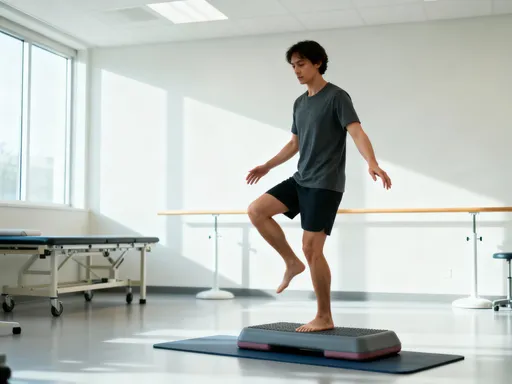
The first time I stood on one leg during physical therapy, I lasted less than five seconds. My ankle trembled, my arms flailed for support, and my face flushed with embarrassment. I had expected rehab to involve weights and stretches, not what felt like a child’s game of statue. Yet, my therapist calmly reminded me that this simple act was not trivial—it was diagnostic. My inability to maintain a single-leg stance revealed deficits in proprioception and core engagement that weren’t apparent during seated or lying exercises.
That session introduced me to basic balance tools: a firm foam pad and a flat balance board. Standing on the foam surface immediately increased the challenge. The unstable texture forced my feet and ankles to make constant micro-adjustments, activating muscles that had been dormant during my recovery. The balance board, with its slight pivot, required me to shift my weight deliberately to stay centered. At first, every movement felt exaggerated and exhausting. But with repetition, I began to notice subtle improvements—longer hold times, less reliance on hand support, and a growing sense of body awareness.
Emotionally, the process was humbling. Admitting that I struggled with something as basic as standing still was difficult. Yet, that vulnerability became a source of motivation. Each small success, like holding a stance for 20 seconds or completing a set without touching the wall, felt like a victory. My therapist emphasized progress over perfection, encouraging me to view wobbling not as failure, but as evidence of the nervous system relearning. This mindset shift was crucial. Instead of feeling discouraged, I began to see each session as an opportunity to rebuild neural pathways, one shaky step at a time.
Over several weeks, the exercises evolved from static holds to dynamic movements. I progressed from standing on flat ground to uneven surfaces, from eyes open to eyes closed, and from narrow bases of support to controlled reaches. These incremental challenges kept the training engaging and effective. Most importantly, I started to notice carryover into daily life. Walking on gravel no longer felt precarious. Carrying groceries up the stairs became less taxing. The confidence I had lost was slowly returning, not through brute strength, but through refined control.
The Core Balance Exercises That Made a Difference
Several evidence-based exercises became the foundation of my balance retraining. The first was the tandem stance—standing with one foot directly in front of the other, heel to toe. This narrow base of support increases postural demand and challenges alignment. To perform it correctly, I was instructed to keep my spine tall, shoulders relaxed, and gaze forward. Holding this position for 20 to 30 seconds on each side helped improve ankle stability and weight distribution. As I progressed, I closed my eyes briefly to reduce visual input, further engaging my proprioceptive system.
Single-leg stands were another cornerstone. Starting near a wall for light fingertip support, I focused on engaging my core and distributing weight evenly across the foot—not just on the heel or ball. The key was consistency: practicing daily, even for just a few minutes. Over time, I increased the duration and removed hand support entirely. This exercise directly targeted ankle strength and neuromuscular control, both critical for preventing future sprains.
Weight shifts were introduced to enhance dynamic balance. Standing with feet shoulder-width apart, I slowly shifted my weight from side to side, then forward and backward, keeping my upper body steady. This movement trained my body to control center-of-mass displacement, a skill essential for walking, turning, and recovering from stumbles. My therapist emphasized smooth, controlled motions over speed, reinforcing quality of movement.
Controlled reaches added a functional component. From a single-leg stance, I reached my opposite arm forward, to the side, or upward, maintaining balance throughout. This mimicked real-life actions like grabbing a cup from a shelf or reaching for a seatbelt. The challenge was to avoid leaning or overcompensating. Cues such as “focus on a fixed point” and “engage your core gently” helped me maintain alignment and reduce unnecessary muscle tension.
What made these exercises effective was not their complexity, but their consistency and progression. Each was designed to build upon the last, gradually increasing difficulty as control improved. My therapist adjusted the program based on my performance, ensuring I was challenged but not overwhelmed. The emphasis was always on proper form and mindful execution, not speed or repetition count. This approach fostered sustainable improvement and minimized the risk of setbacks.
How Balance Training Integrates With Overall Recovery
Balanced recovery is not a standalone practice—it is deeply interconnected with strength, flexibility, and functional training. While strength exercises rebuild muscle, and stretching restores mobility, balance training integrates these components into coordinated movement. For example, a strong quadriceps muscle supports the knee, but without balance, that strength may not translate into stable walking on uneven ground. Balance acts as the conductor of the body’s orchestra, ensuring all systems work in harmony.
One of the most profound aspects of balance training is its role in retraining the brain-body connection. After an injury, neural pathways that govern movement can become disrupted. Balance exercises stimulate the central nervous system, promoting neuroplasticity—the brain’s ability to reorganize and form new connections. This is especially important in the functional phase of rehab, where the goal shifts from healing to real-world performance. By practicing controlled, intentional movements, the brain relearns how to respond to sensory input, improving reaction time and coordination.
Balanced training is adaptable across all stages of recovery. In the acute phase, gentle weight-bearing activities on stable surfaces help restore confidence and circulation. During the functional phase, dynamic exercises on unstable surfaces challenge control and mimic daily demands. Finally, in the return-to-activity phase, sport-specific or task-oriented drills ensure readiness for full participation. This phased approach allows for safe, progressive advancement without rushing the process.
The applications of balance training extend beyond ankle injuries. It is beneficial for knee rehabilitation, particularly after ligament injuries or surgeries like ACL reconstruction, where joint stability is compromised. It also supports recovery from hip replacements, stroke, and even chronic conditions like arthritis. By improving postural control and reducing joint stress, balance training enhances overall mobility and reduces the risk of secondary complications. Its versatility makes it a valuable component of nearly any rehabilitation plan.
Common Mistakes and How to Avoid Them
Despite its benefits, balance training can be ineffective or even counterproductive if approached incorrectly. One of the most common mistakes is rushing progression. Eager to regain stability, some individuals advance too quickly to challenging exercises without mastering the basics. This can lead to poor form, increased fall risk, and discouragement. A better approach is to master each stage before moving on, ensuring that control is consistent and automatic before introducing greater complexity.
Another pitfall is ignoring pain or discomfort. While mild muscle fatigue is expected, sharp or joint-related pain is a warning sign. Pushing through pain can exacerbate underlying issues and delay healing. It’s essential to differentiate between the discomfort of effort and the signal of injury. When in doubt, stopping and consulting a professional is the safest course of action.
Over-reliance on visual input or hand support is another frequent error. While using a wall or counter for safety is appropriate in early stages, prolonged dependence can hinder progress. The goal is to reduce reliance on external cues and strengthen internal feedback systems. A practical strategy is to start with light fingertip support and gradually progress to hovering the hand nearby, then removing it entirely as confidence grows.
Skipping warm-ups is another oversight. Cold muscles and stiff joints are less responsive, increasing the risk of strain during balance exercises. A brief warm-up, such as marching in place or ankle circles, prepares the body for activity. Additionally, tracking progress weekly—noting hold times, stability improvements, or reduced support use—provides motivation and objective feedback. Finally, working with a qualified physical therapist ensures the program is tailored to individual needs, maximizing safety and effectiveness.
Building a Sustainable Balance Practice Beyond Rehab
One of the greatest lessons from my recovery is that balance is not a temporary fix, but a lifelong practice. Even after formal rehab ended, I continued integrating balance exercises into my daily routine. Simple habits, like standing on one leg while brushing my teeth or waiting in line, keep the skills active without requiring extra time. Mindful walking—paying attention to posture, stride, and foot placement—has become a form of moving meditation that enhances coordination and presence.
The long-term benefits extend far beyond injury recovery. Improved balance contributes to better posture, reduced lower back strain, and enhanced athletic performance. It also plays a critical role in injury prevention, especially as we age. Falls are a leading cause of injury in adults over 50, and maintaining strong balance can significantly reduce that risk. By viewing balance as an ongoing investment in mobility, individuals can enjoy greater independence and confidence throughout life.
This journey has reshaped how I think about fitness. It’s no longer just about how much I can lift or how fast I can walk, but about how well I can control my body in motion. Balance training has given me a deeper connection to my physical self, a renewed sense of stability, and the assurance that I can navigate life’s uneven paths with greater ease. It’s not flashy or dramatic, but its impact is profound.
In closing, balance is not an optional extra in recovery—it is a fundamental pillar of functional health. Whether recovering from an injury or maintaining wellness, dedicating time to balance training is one of the most empowering choices a person can make. It fosters resilience, prevents setbacks, and restores confidence in everyday movement. While individual needs vary, the principle remains universal: stability is not just about standing still—it’s about moving forward with confidence.
Always consult a qualified healthcare provider before starting any rehabilitation program. What worked for one person may not suit another—personalization and professional guidance are key.